Wednesday, August 12, 2020

Hospital Playlist (2020) The Life and Loves of Chae Song-hwa

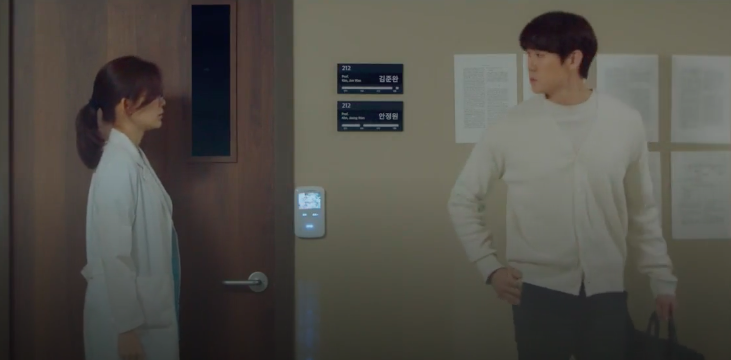
Yesterday after posting my article on the WG dynamic, I was asked whether I thought Song-hwa would end up with Ik-jun or Chi-hong. It's a question I've been asked about and debated before so I thought it might be good to address it at some length here.


To put some background to this and lay all my cards on the table, it seemed to me quite early on... by Episode 4 to be exact, that the drama was indicating in no uncertain terms that Chi-hong had romantic feelings for Song-hwa particularly as he was the only one that showed up at the camping ground. To be honest I was amenable to the idea of a male subordinate being in a relationship with his workplace supervisor especially because Chi-hong was/is an immensely likeable human being who was/is mature and down-to-earth. There's a relatable authenticity about him that I gravitate to. I, like a lot of others thought he was great husband material from everything we saw. Personally I wanted this one to happen... probably even more than Winter Garden because I thought it would be really groundbreaking in some way if it did. The power dynamics would be fascinating to explore. Plus... I adored Chi-hong (still do) and wanted him to have his happily-ever-after. I was frankly annoyed with what the show did with him... and made him an enemy of many viewers for "crossing the line" in Episodes 10- 11. I was uneasy about that although he wouldn't be the first male in a Korean drama that did it and I understood it as an expression of the military man in him: All's fair in love and war etc etc. What I resented about that whole incident was how the drama seemed to be using Chi-hong to spur Ik-jun on to make his confession... truth be told.

I can see why people love their Ik-Song. Jo Jung-suk always has great chemistry with his co-stars and many perceive him to be the male lead. Some people have a thing for musicians. :D I enjoy Ik-jun -- the good, the nutty and the friendly. I'm certainly very neutral about the whole thing so I'm not necessarily in the front row cheerleading for them to be a couple. But I'm a canon sort of person 9.5 times out of 10.

The reason why I remain neutral and I certainly won't be putting all my eggs into that basket is because of Song-hwa herself. All of this rests on how she perceives the men and her relationship to them. I've heard it said that she's a hard one to read but I personally don't think so. Her role in this first season is very specific... as I've said in my episode retrospectives. She sees herself as the Sage. That's absolutely clear when Jae-hak walks into her office and she rejects IJ's overtures to tempt her with food. It's obvious where her priorities were then. The thought of being confessed to by two men close to her... one a student, the other a very old friend... is deeply unsettling. I think there are good reasons for that. She resists a change in dynamics with them because she values what they already have. That's why she tends to date outside her immediate circle of relationships. Why would she want to disrupt the status quo for an uncertain romantic outcome and lose everything as a result? 

Now that the entire first season has aired, I am very doubtful that Song-hwa will change her mind about Chi-hong. It seems like the show has burnt that bridge sadly. With Ik-jun, I frankly don't know. There are two more seasons to go so and since Ik-jun's one of the Flawed Five and very keen, he may have another shot at this. Plus he has secret weapon U-ju.

The possibilities as far as I'm concerned are as follows:

1) Song-hwa could end up being a contented single 40-year-old career woman even after 3 seasons. It would be groundbreaking to say the least. For a Korean drama that is. It would certainly, as I've said to online friends, overturn a familiar trope that a "lead" female character "has to" ride off into the sunset with one of the male leads. It would also put to rest once and for all the argument that Writer Lee U-jung only knows how to write Reply type stories.

2) Song-hwa ending with Ik-jun is definitely a contender because of the foundations that the show has already laid. Once upon a time these two people liked each other but they moved on. One of them even got married to someone else and had a child from that relationship. However, for them to pair up as I've said on other occasions, she will want to be sure that all the other men have their happily-ever-after. I say this because I'm sure that both Song-hwa and Ik-jun moved on in consideration for their friendship with the other guys. This is a friendship that has lasted 20 years surviving all kinds of tumult so it stands to reason that she's chosen to prioritize it. She won't want to shake things up until she's sure that there won't be a falling out among the Five because of this.

3) Song-hwa could end up with someone else we haven't met as yet. Someone from church maybe. This is the least likely scenario but I'm throwing it out there for public consumption. Again, it would be out-of-the-box thinking on the part of the show for her to be dating or married to some nobody guy outside of the hospital context at the end of season 3.

4) We could all be wrong and Song-hwa might change her mind down the track about Chi-hong but I'm not optimistic because of how Episode 12 ended for them. Still, she's not going to be in Sokcho forever, I imagine.

As I've said, everything hinges on what happens with her next season. Except for some random unreliable doctor from outside the hospital, romance wasn't really on the agenda for her in season 1. She was everybody's adviser, teacher or confidant. That's an amazing thing that the show did to be honest. And to give the most significant romance arcs to so-called side characters can be said to be almost innovative by Kdrama standards.

Tuesday, August 11, 2020

Hospital Playlist (2020) The Epistemology of WinterGarden

I imagine that everyone who is reading this knows that for one reason or another I became some kind of online defender of the WinterGarden pairing. No one is more surprised about that than I am. It was never my intention to promote a fictional romance for its own sake and go to battle for it. It was ludicrous then as it is ludicrous now. Although I am thankful that people enjoyed what I had to say and I don't take that for granted, the reason why I jumped into the fray was because I believed at the time that the show was being misinterpreted and sending open-minded viewers into confusion, rage and angst. It's true that people are entitled to their opinions... I don't begrudge them that (it's a tv show after all) but they're not entitled to twist the facts to suit their own purposes. Or at the very least, they shouldn't get a free pass for doing so. 

These days I've become very fond of the WG dynamic. I liked Gyeo-ul first and then I gradually became fond of Jeong-won. Even in Episode 3 I could see what the showrunners were doing but I didn't get onboard from the start because I don't watch medical dramas for romance. At around Episode 5 I became convinced that the show was serious about developing a connection between them so I climbed into the bandwagon prepared for the fact that this was going to be the stuff of slowburn. An aspirant to the priesthood being paired up with a shy unassuming 3rd year GS resident... it wasn't going to be love at first sight. (Love at first maggot maybe) But the show seemed to be tying their dynamic to the question of whether Jeong-won was staying or leaving. Time and time again, there were voices saying that it was a one-sided crush. This is how it went... Jeong-won is Mr Nice Guy and he's lovely to everyone. He's not romantically interested in Gyeo-ul blah blah blah. You know the drill. Of course I kept an open mind but over time, the charge that it was a one-sided crush became less and less convincing. Especially when the camera continued to firstly, focus on Jeong-won's reactions to Gyeo-ul's doings and then frames them together in shots as they interact in the ER, the PICU and of course the OR. Why do that... if she's just a "side" character with a cute "one-sided crush"? It made no sense to me unless I am supposed to conclude that Ahn Jeong-won notices or interacts Jang Gyeo-ul in a way that is outside the norm. 

In Episode 4, when they're both waiting for the lift to arrive, why focus on a back shot of the two of them? Why is the Mr Nice Guy Ahn Jeong-won being awkward and doesn't initiate the hello? Why can't he have a normal conversation with her like he does with other women in the hospital if he's really as nice as we're told? Then during the OBGYN-Pediatrics conference, he glances at her devouring chocolate cakes. Later as he gets up in readiness to leave, he pushes two packets of her favourite cakes across the table to her. The point being that he only does it for her. Not for anyone else. If he is such a nice guy like everyone insists that he is, why doesn't he distribute the rest of the confectionery to everyone present the way she did at the start of the conference?


In another episode, Hui-su, a familiar presence in the ER tells Bae Jin-hui that Jeong-won agreeably goes out with women at work whenever asked so she's nothing special to him. This gives Gyeo-ul, who overhears this exchange, food for thought and she seeks him out. However, when Gyeo-ul puts the question of dinner to Jeong-won, he turns her down quickly citing a visit to mother on the weekend as his excuse. Why does the show do this? To tell us that Jang Gyeo-ul is nothing special to him? That he finds her abhorrent? So why lie about his weekend? If he apparently goes out with female staff routinely, why doesn't he do it in this instance? He's clearly breaking the pattern of the norm for some reason. This instantly made me suspicious. What's even more compelling is that the show goes to the trouble of setting up both scenes as obvious contrasts. 

From Episodes 2 to 12, there are repeated instances where we are asked to look at Jeong-won's behaviour towards Gyeo-ul as a series of exceptions. In his mind, she is an exception and stands out among all the women. Even if a viewer doesn't particularly like Gyeo--ul or Jeong-won, it can't be denied that the show puts them together in such an obviously consistent way that no one can say that the resolution to their slow burn romance came as a surprise. And if anyone wasn't that convinced, the show brought in the scrub nurse and Rosa to tell us unequivocally that Gyeo-ul is special to Jeong-won and that he treats her differently.

These are the facts. The show gives us plenty of them. Sure, it's possible to say that the way the romance was constructed and developed was not to your liking. I can appreciate that opinion. People have unmet expectations of what a romance looks like. People don't all like the same things. But that doesn't change the facts that were put in place over time to highlight that these two people had a particular dynamic that was exclusive to them. 

To deny that is to deny the story that the show is telling. That's the part I find baffling. In all my years of watching dramas I've never come across such a systematic reinterpretation of a drama that's not a fanfic or parody by disregarding facts or dismissing them because of egregious bias. I have my own criticisms of the show... particularly regarding what they did with Chi-hong towards the end but I'm not going to insist that despite all that's said and done, Song-hwa is secretly in love with him because she doesn't know her heart just because it's my preference. Song-hwa has spoken loudly and clearly. I take it at face value. Moreover it's consistent with the rest of her behaviour in the show even with Ik-jun. There is an objective reality that exists in the drama where the characters do and say things. If we can't trust any of that because it doesn't mesh with our prejudices then what can we trust? The quality of evidence for one's position has to be there. 

It's obvious that our battle was in large part to do with deep prejudice against Gyeo-ul and possibly certain unmet expectations. Expectations that Song-hwa, the female lead has to be at the centre of a reverse harem or a love triangle. The men have to be fighting over Song-hwa... apparently... it's a given because we're drama watching bots and because Kdrama writers have no creativity. The irony of course is that Song-hwa by the end of the first season is happily single after not being all that happy to be confessed to, not once, not twice but at least four times. Moreover, why would a 40 year old woman be in a middle of a love tussle with men she's known for years? It doesn't make sense. Jeong-won least of all because he'd signed up for the idea of religious celibacy for years. As I've argued, the show is unerringly logical and the people behind it have a profound understanding of human behaviour. People don't change easily. When they do it's because of upheavals in their lives. So for Jeong-won to not go to the priesthood, it has to be something very very different. Exceptional even.

Gyeo-ul was the show's choice for Jeong-won for many good reasons. I've outlined many of those in my episode retrospectives. But most importantly she is meant to be a balance to his over empathetic nature. His calling was always medicine. He got it right the first time but the emotional baggage that came with the job eventually took a toll on him. We are told that pediatric surgeons are a scarce breed of doctors. Jeong-won works on his own. Gyeo-ul was the only GS resident. So it makes sense that he would eventually gravitate towards her because they would be thrown together daily in a professional capacity. The reason why the camera lingers on him while she's picking off maggots is because it is a record of a significant paradigm shift for him. Why do it otherwise? It was supposed to be her moment and yet it became his moment too because he was forced to change his mind... and think more favourably of her. Whatever his reasons for being there in the ER, his being there changed him, her and eventually them. 

If for instance, Jeong-won is meant for someone else, why would the show go to all the trouble of setting up all these moments and confirmations? The question that I have for those who say that the Winter Garden is a mere flash in the pan is this: What is the evidence for that? Why are the facts that were given to us insufficient? Because the conclusion of the first season validates what most of us understood the show to be doing. That means that we followed the evidence accurately and came to the right conclusion ahead of time. This isn't just a mere matter of being happily delusional which is the delight of fanfiction writers everywhere. This is about claiming a kind of authority... about who has the right to speak and say what's what. If someone can look at the confession at Episode 12 and say that it's just somebody's dream, why can't I say that the whole show is somebody's dream? Why don't we take it to its logical conclusion? At what point is the show real and at what point is it a dream? Who gets to decide that? 

There's an easy answer to that of course.

I'm fine with non-canonical pairings. I have been known to enjoy well-written fanfics of non-canonical pairings. But I hope I know the difference. In a way the battle wasn't about Jeong-won and Gyeo-ul but about who had the right to tell us how to think about the show.

To insist vociferously even now that Jeong-won and Gyeo-ul are not the endgame isn't just a preference issue. It's, I think, missing the point. There are reasons why Jeong-won didn't fall for Song-hwa, Bae Jin-hui and all the other women who have been a part of his life journey. All of that feed into who he is as a man and the overall messaging of the show. People make plans. Life is unpredictable. Unpredictable things happen. People change their minds. To me that's the big story of Hospital Playlist. Furthermore let's take a look at Gyeo-ul. She's not exactly strikingly beautiful or charismatic. Not your typical lead Kdrama lead female. I imagine that's the objection from some quarters. But that's exactly the reason why Jeong-won fell for her. It wasn't for her looks first and foremost because he was surrounded by beautiful women his entire life. He saw another side to Jang Gyeo-ul during the maggot scene. That beautiful, gracious act made her beautiful to him. There's a well-known verse from the Old Testament in the Bible that relates to this:

The LORD doesn’t see things the way you see them. People judge by outward appearance, but the LORD looks at the heart.” (1 Samuel 16:7 NLT)

As far as I'm concerned, everything in Hospital Playlist happens for a reason. It's a show that does things very deliberately. The moral universe is one that has a place for all kinds of people including Jang Gyeo-ul. Do we dare say only outwardly attractive people deserve to be loved? Don't we agree that this show pays Ahn Jeong-won the highest compliment... by insisting that he is a man of great substance because he can do better than judge a woman by her appearance?


Reunion: The Sound of Providence (2020) So Far...

Zhu Yilong first came to my notice when I stumbled on a recent adaptation of Gu Long's Bordertown Prodigal. There was something about his eyes to be sure and I suppose I have some kind of fixation with "eye actors". You know what I mean... those who do magical things with their eyes. I've seen them called "soulful" -- an assessment which I'd agree with heartily if by that one means that there's a well of depth and rich emotion in them. The character he played in that series, Fu Hongxue, was in effect a tortured soul (and not many do angst better than Zhu Yilong) that was raised to do one single thing... to avenge his father. A typical tsundere male. Although he is tasked to make a certain lady fall in love with him he goes and does something silly like fall in love with her. Of course that's not all there is to this drama because there's all kinds of plotting of scheming going on in the background within the martial arts community. The drama is fine for about 2/3s of it but then the wheels gradually fall off in the final act. All that to say that when I first heard that Zhu Yilong was named as the lead character in this, I was more than a little bit interested. 


Reunion is the latest in a string of adaptations of the Grave Robber Notes/ Chronicles, a series of Indiana Jones-style adventures revolving largely around a trio of male explorers who as the title suggests go exploring, treasure hunting and solve mysteries in and around ancient tombs around China. The main character, Wu Xie comes from a line of tomb raiders/archaeologists so the spirit of adventure flows through his veins. He is a descendant of the 5th Master in Mystic Nine, the prequel to the grave robbing tales.

In this latest instalment, the show begins with Wu Xie as an older man, inching towards 40, living in retirement with his loyal sidekick, Pangzi (Fatty). Although they're supposed to be in the antique business, they barely get by selling vases and earn money on the side as consultants regarding archaeological matters. The third in this "Iron Triangle" is Zhang Qiling aka Xiao Ge, an enigmatic skilled fighter whose role is to rescue the others from tight spots. He seems to have discovered the Fountain of Youth because he is far older than he looks. He, on the other hand, has chosen to retire in the mountains.

The story really begins when Wu Xie stumbles onto a series of coded messages from his third uncle who disappeared two decades earlier. Wu Xie who is suffering from late stage lung cancer, is up for a last hurrah to find out what happened to the man who was more like a father to him. 

To solve the mystery of uncle's disappearance, Wu Xie first of all has to solve another mystery of what happened twenty years earlier during an archaeological expedition that his beloved uncle was involved in. Third Uncle and his team were researching the Thunder God mythology in a south sea underground temple when a series of mishaps occurred. 

Much to his chagrin, his Second Uncle insists on being involved. Wu Xie reluctantly acquiesces when he realises that his uncle has got the manpower and the resources to launch a full-scale operation that he doesn't. Second Uncle has got his own agenda. The woman he loved was the expedition leader but she allowed her need to prove something to colour her judgment. Moreover she entangled herself in a love triangle involving Third Uncle and another member of the group. 

I don't have much to compare to. I waded through Mystic Nine which fell prey to the censor's sword in the most absurd fashion. As a standalone drama, this one works for the most part except it suffers from the same sorts of issues that C dramas are prone to. Filler that includes bad slapstick to make the episode cut. Badly written female characters. Badly written romances. The usual things. ;)

Apart from all that, I'm enjoying it. Zhu Yilong and most of the gang make it work. Zhu Yilong is especially good. He fleshes out Wu Xie and like all the great ones, he has a whole parade of expressions that he draws on that gives depth to the character. In short, he nails every scene and every moment. The lad who plays Fatty, Chen Ming Hao is pretty good with the comic delivery and inhabits the character perfectly. 

This first season splits into two main arcs. The first sees the expedition focused mainly on the south sea region and the second has Wu Xie caught up in a mysterious facility known as Warehouse 11 which I've been told is derived from the US television series Warehouse 13 with less of the spooky but more of the murderous. On some level I'm enjoying the second arc more. While I love the male camaraderie and all the leap-off-your-seat moments of the first, the investigative work within Warehouse 11 with the adorable Xiao Bai, his guide and helper relating to all matters Warehouse 11, is rather a bit more fun. Could there be romance in the air for Wu Xie? A part of me hopes so. Otherwise it would be a waste of those eyes. Besides, Wu Xie gets to show off his detective skills which always goes down well with me.

(Repost... more or less... from Soompi:)

Although I'm largely not a fan of the individual women in this show (Xiao Bai an exception) I can sort of see why they're included in it. It struck me in the last few episodes that the women with varying degrees of intelligence, are attracted to danger on some level whether they are cognizant of it or not. Perhaps there's even a suggestion that they're female versions of their male counterparts. I'm not exactly a fan of Piaopiao (Fatty's love interest) but it occurred to me that despite the jeopardy she's put herself and her daughter in, she has been persistent in continuing with the antique delivery work. This is despite the fact that Pangzi tried to cut off contact with her to keep her out of harm's way. His rationale was that she was someone who could have no part in the antique trade and by extension could never be part of his world. Whatever we think of Piaopiao... she mightn't be the brightest light bulb in the room... she is drawn to that world either by instinct or by necessity. That's the same with Mute Girl and Xiao Bai. Even while they might appear to be "domesticating" influences, they seem to be drawn to men who live on the wild side. 

Another reason why I think the women were introduced is because this is also a drama about ageing and death. (Regardless of what the other dramas were like) Wu Xie himself has observed this in recent days especially because he is facing impending demise. The Iron Triangle have been together for a long time but as Wu Xie believes that he's living on borrowed time, he is naturally concerned about how his friends have felt obligated to remain with him. Life after Wu Xie  is very much in his thoughts especially in Pangzi's case. As a good friend and brother-in-arms, he must feel some regret that he's dragged the other guys around dark and damp places with him to the point where they have no lives of their own. He even notes that Pangzi has needs that even their friendship are inadequate to the task. This is consistent with the rest of his character. Not only is he loyal to his buddies, he is a thinking person that considers the possibilities. He assumes that he isn't going to be around forever so he wants Pangzi taken care of and happy. Whether or not we think he is going to actually die is irrelevant. He thinks he's going to die and he is on the journey of dealing with unfinished business... Third Uncle's disappearance and his buddy's future.

While I myself noted that the show was using a gaming level up feature in Warehouse 11, I certainly don't think that it's all there is. The levelling up process is to expedite matters for Wu Xie but someone wants him in Warehouse 11 to do some house cleaning. It's obvious that there's a lot of dodgy stuff going on in Warehouse 11. Director Ding for one is dodgy beyond words. Somebody cares about that and wants a good shake up and permanent "restructuring". That is the real reason why he's been brought in. Someone recognizes that he has the drive and deductive skills to achieve this. He's smart and  he doesn't back down at all. As Xiao Bai says, he looks at things differently from other people... and a lot of that comes from his experience raiding tombs and chasing "ghosts".

It reminds me a little of the 90s British detective show Jonathan Creek who designed sets for an illusionist. He was able to see behind the "smoke and mirrors" of each case because he has a particular kind of mind that is used to looking at things from a particular perspective.

And we saw that for instance with Wu Xie's entanglement with the Spirit Vase case. It was obviously Scooby-Doo set-up but it takes an out-of-the-box thinker to get to the bottom of things.

I can't say definitively that Xiao Bai is a long-term love interest. But I am sure that she is someone who is meant to make him think about what his life might have been like had he stayed at home and not gone gallivanting around the world with his brothers-in-arms. That's why he refused to answer her question about his "type" and quickly changed the subject to her "type". My guess is that despite the age gap... she is in all likelihood his type. When she brought him into her room the first time, he walked in and made himself comfortable very quickly like they've been a relationship for a while. When she offered him a drink, he took it as if he wanted another reason to spend more time with her.

These days I don't make rules for myself about romance. Whatever it is a show aims to do, my rule is simply this: I want it done well. I don't want females to be included as tokens but if they are included, they have to make sense in light of the bigger picture. We're nearing the half-way mark so there's a lot more to come. We don't know how these women will factor in down the track. Since I've made the decision to watch this show, I'll give it a chance. I have no qualms dropping it if it turns into a train wreck.

Monday, August 10, 2020

Hospital Playlist (2020) In Defence of Ahn Jeong-won -- A Repost

As I gradually decrease my involvement with Soompi, I will be posting my opinion pieces and analyses on this blog with greater regularity.


I am supposing from comments here, there and everywhere that there is a very long line of people who would like to punch, kick and smack JWon for 1) giving Gyeo-ul a cold shoulder in those early days 2) taking his own sweet time with his confession. I hear you all and I can't blame any of you for feeling frustrated in the entirety of the original run. The thought that he sat on his confession for at least 3 weeks... well yeah... I too would like to give him a good shake (at least) and ask him why. I have lots of questions for him even though I can probably guess the answers to most of them.

But in his defence, our guy had a lot going on in his head. It was always going to be a hard ask for him to switch gears easily. I think we have to give him some credit for having some principles and sticking to them for as long as he was humanly able. (In that way the show was being realistic) After spending a bit of time in what I think is his head... I have more sympathy for his position. He'd wanted to be a priest for almost all of his life. And he proved to some degree that he was on track. Finally the wheels were in motion and then voila... he meets a girl that he likes. It couldn't have been that easy for him to accept that. As everyone who hasn't been living off the grid knows, I don't think he should be a priest and I don't think God wants him to be one either. I think it was obvious from the start (when he went crying to his big brother) that he wasn't a suitable candidate because the priesthood has pastoral demands that his personality is ill-suited for. His over-empathetic nature would leave him burnt out in no time.


Meeting Gyeo-ul was accidental. It was the biggest surprise of his life undoubtedly. But in the Christian universe... it could arguably be said to be providential. But he had to grapple with that over months because let's face it, no one changes their trajectory easily especially if it conflicts with your most core beliefs in some fashion.


When I look at the ER scene and watch him panic run down the hospital corridors and up the fire escape stairway, it's obvious that he fell hard for her. In a real enough way the person who was most surprised by all this was probably JWon himself. It went to the core of who he was. The man that he thought he was, was experiencing a whole different set of emotions foreign to his understanding of himself. It rocked his view of himself as an aspiring priest. It forced him to re-evaluate as a single, celibate man. In some ways he was like a teenage boy experiencing love for the first time. He didn't have bearings regarding how to understand where he was and the tools to deal with Gyeo-ul after declaring that "she doesn't suit me". That was certainly the case in Episode 5 where he didn't scold her or praise her or make any kind of reference to her chasing down DV dad. Clearly he was upset by it but for some reason he chose to give her the cold shoulder because I would surmise... he really had no idea how to react to her. She was the anomaly in his life that caused him to break his patterns of interaction.


Although I'm sure the showrunners didn't want us to get too bogged down by the WinterGarden dynamic and for the couple involved to be defined by it, at the end of the day, it was inevitable that their dynamic became much bigger than they as individuals. It was was partly the approach they took and the fact that many people watch K dramas for the romance. For better or worse. But the fact was, despite all the detractors from all stripes, the WG is an integral part of JWon's journey to find his true calling. At the end of the day it wasn't a minor thing like a mosquito bite which he could brush off. I've seen people say that they didn't care about the romance or watch HP for it. Well, I didn't approach HP with the view to shipping anyone. But it became increasingly obvious that the show made it an issue. For JWon it was never a side thing. It couldn't be if it caused him to rethink every single thing. Romance was crucial for him in a way that wasn't for the other four. 


Rosa was right at least in acknowledging that Gyeo-ul would be a significant variable in how JWon goes forward. She didn't know everything. But she saw enough to give her hope that her recalcitrant youngest son could be persuaded to change his mind even when no one else could. Not Rosa herself, not his oldest brother, not his friends. Certainly not Song-hwa. Can we honestly say that the romance doesn't matter? It was set up by the showrunners in such a way as to say that it was certainly a factor in whether YYS comes back for a second or third season as a pediatric surgeon. Nobody that was familiar in JWon's life prior to his working at Yulje had the power to change his trajectory.


I have no idea how far ahead the showrunners have thought about the future seasons but I am at least certain that keeping JWon in Yulje is part of some bigger plan for the hospital. For me he has always been Peter Pan  and getting him out of Neverland is only the start of something else that related to the leadership of the hospital. Again I feel that the WG dynamic has a part to play in that.

It's Okay not to be Okay (2020) Episodes 15-16

Nothing about the last couple of episodes really came as any great surprise. Which is good news. It was all it should be and it was gratifying to see so much care and attention to detail given to the finale. As expected Sang-tae and Mun-yeong's first collaborative effort was not only autobiographical but was brimming with newfound hope. Wherever life takes them, the future looks brighter than before.

I applaud the show for staying true to its vision. The vision (I believe) was always to tell the story of 3 troubled individuals in accordance to a fairytale template and see them finding their happily-ever-after. The level of quality was consistent all throughout while successfully managing the juggling act of incorporating the stories of side characters into the arc of the main trio. As someone who loves stories and spend time obsessing over storytelling I believe that this show has done a superb job in that regard. It certainly begs the question as to why we don't see this kind of consistency more often. It seems to me often times that writers and directors are so desperately trying to be different for its own sake that they're quite prepared to destroy their own drama by their own hands with a meaningless resolution that has nothing to do with the rest of the show. One may conclude that the difference between a decent drama and a bad one in many instances lies in the consistency of its moral universe. A good one knows exactly what it wants to be and goes for it.

I don't suppose that there was much doubt that Gang-tae and Mun-yeong would find their way out of the abyss and slay the enchantress dragon because they've had a taste of what the alternative could be -- the warmth of a committed, loving family. Of course that doesn't take away from the fact that Do Hui-jae killed Gang-tae's mum. Facts are facts. Evil is evil. Its existence vanquished but not erased. But as the gesture of Sang-tae painting over Park Heng-ja's butterfly on his mural suggests what was supposed to be evil... the butterfly motif can be reinterpreted for good. It reminds me of what Joseph from the book of Genesis said. "You meant evil against me but God meant it for good, to bring it about so that many people should be kept alive, as they are today." They had sold him into slavery but in the way of unintended consequences, Joseph became the Prime Minister of Egypt during a famine and because of that their entire family was saved. Whatever guilt or misgivings that Gang-tae and Mun-yeong may have will be replaced by all that is good and true.

I'm not especially disappointed that the show did not explain Do Hui-jae's near death experience. I don't think it really needed to. The show wasn't about her. Because Do Hui-jae, the shadow witch, the Maleficent figure in this story is largely relegated to a kind of metaphor of persistent evil. She didn't die that time because well, evil isn't so easily eliminated. At least in that universe. She came back from brink of death because the show needed a malevolent force casting her shadow over the hospital and its inhabitants. In the end she was for the story a representation of pure evil that had to be defeated by the protagonists variously. Do Hui-jae aka was the tyrannical Mother who took on the facade of the wise Caregiver to ensure that her legacy lived on as she stalked the husband that tried to kill her. For us mere mortals it makes little sense. Why would a woman or anyone go to such extremes to prove that happily-ever-afters don't exist? Psychopathy, I'm not convinced, explains it all. 

Episode 16 was in my view, an unequivocal celebration of the individual but not necessarily in tension with the rest of the society. There is a sense that when individuals thrive, the community reaps benefits. That's evident with regards to Sang-tae. At the start of the drama, he is derided as a misfit reliant on his brother but eight weeks later when he finally finds an outlet for his artistic ability, he flourishes. His happiness is contagious and freeing. When he's showing off his new book to his mother's newly planted tree, he's not the only who's happy. Gang-tae is in the background with tears streaming down his cheeks genuinely happy for his brother as we are. No more mask, no more need for pretence. What's deeply poignant is that Sang-tae can now let his brother go with no fear: "Moon Gang-tae belongs to Moon Gang-tae." It's a declaration that they are each their own man even while they're siblings. Being brothers isn't a life sentence nor an obligation but a dynamic that undergoes change and develops over time. Because he has achieved something with his own hands and he now has his own goals, Sang-tae is secure within himself. He is not an appendage of his brother nor is his brother constrained to live primarily as his primary caregiver even if he's quite willing. This doesn't come at the cost of family and friendships... or any kind of a supportive community... the show is strongly communitarian. In fact, the community might end up being the biggest winner. But there's also a clear message that when individuals are ignored or undervalued, there will be other costs that society or their community will have to bear. There's a lovely roll call during the book reading of those who once took refuge under the It's Okay space: Kwon Gi-do, Kang Eun-ja were present at launch and their stories were referenced in the book.

In truth the happy ending isn't that Gang-tae and Mun-yeong end up together. Or that the villain gets thrown behind bars. Or even that Sang-tae becomes a professional illustrator. All of which are certainly desirable outcomes. The biggest triumph is for all three of them is that they overcame their particular deficiencies to plumb the possibilities... and what they're capable of... when push comes to shove. Before they came together in an almighty clash, they were in a rut going through the grind of daily living in survival mode. The Wizard of Oz allusions points to the fact that like the Scarecrow, the Tin Man and the Lion, the characters each had potential which was lying dormant. It was always there within them and what they needed was the journey and the biggest challenge thus far in their lives for those qualities... bravery, love and strength. United they stood. They passed the final test.

Sunday, August 2, 2020

It's Okay not to be Okay (2020) Episode 14

As the show nears its end, everything is set up for the final showdown in Ko Mun-yeong's and Moon Gang-tae's own Sleeping Beauty story. Whether Park Heng-ja is really Do Hui-jae might still be up for grabs but it doesn't detract from the fact that she represents the malevolent force that has to be contended with. She might not be Mun-yeong's childhood Maleficent but she is the dragon that has to be slayed in Gang-tae's odyssey. It seems to be the show's contention that the abyss can't be sidestepped, it must be overcome step by step. Otherwise the happily-ever-after will remain a pipe dream. 

It does boggle the mind as to how Do Hui-jae could have survived that fall on such hard flooring and with all that blood loss. However, I don't hold out much hope for a logical scientific explanation for all that. :D If indeed Do Hui-jae has come back from the dead.

As an aside, the cover illustration of the monkfish reminds me of the ones that I've seen in Dr Seuss books and perhaps that's deliberate. A children's book with layers of meaning with lessons for the young and the adults alike. The monkfish story presents itself as an echo of the theme that runs right through the drama about parenting. It's the culmination of an ongoing conversation that Ko Mun-yeong has been having with her parents in absentia, all the time she has been writing children's books positioning herself and speaking through these chimeric characters. They have represented aspects of her self. She was raised in extreme fashion to be her mother's puppet, sculpture or empty vessel. The limbless child that's no better than a monkfish is an immobile beast that can't do her mother's bidding or function in the real world is discarded. The analogies are explicit in their condemnation that parents might bring children into the world to do their bidding... to be their "works of art" to show off to the world. It reminds me of Kwon Gi-do's siblings who can be shown off to the world with pride during an election campaign while the black sheep of the family has to be hidden in a mental institution never to be referred to in polite company. 

For me the most important reason why Do Hui-jae has to be the killer of Moon Gang-tae's mother or at the very least believed to be her murderer has more to do with Gang-tae's identity and understanding of what family means. I could say that it is important for Gang-tae to know how much he loves Mun-yeong... or for Mun-yeong to know how much he loves her to bear those wounds for her sake. For her to know that he would be prepared to overcome all the anger and hate to spend the rest of his life with her, is an enormous gesture on his part. It's mind blowing. It's absolutely inhuman. But it is meant to bear testimony to the transformative power of love. Whoever Park Heng-ja is isn't so crucial in the scheme of things. What is important is what kind of man Moon Gang-tae really is. Or who he wants to be. As he said in the last episode, he was forced to care for his brother and then to work as a caregiver but now being a caregiver... is really what he wants to be. That is... if you like... his true calling. His whole, better self. He wants to be the one who stands between the vulnerable and their darkness as he did for Seon-hae, Jung-tae and A-reum. His confrontation with Park Heng-ja is a vital part of that authentication of his truest self and his protection of his new family. 

Park Heng-ja who could be Do Hui-jae, wants him to run away from Mun-yeong. That's her goal undoubtedly. To remove the obstacle between her and Mun-yeong... her knight in shining armour... by ripping on his wound and dancing on it. He is the one standing in her way. So this is a test of his mettle. What he couldn't be to Mun-yeong as a boy... can he be that person now... as an adult and a man who is better equipped to rescue her from the clutches of her Maleficent figure. To the mind of Maleficent Gang-tae's influence is unwanted because he is gradually eroding and destroying the darkness that had consumed her by bringing light in. This is the fight of Gang-tae's life. His biggest battle wasn't finding out and processing the fact that Do Hui-jae killed his mother but to convince Mun-yeong that he loves her by what he does afterwards with that knowledge. This is the fight that will determine who he is and what kind of future they have.

I am reminded here of the Do Hui-jae's final manuscript... The Murder of the Witch of the West Vol. 10. With that my thoughts turn to Dorothy, the Lion, the Tin Man and the Scarecrow all heading towards Emerald City to fight the Wicked Witch of the West and free her slaves. Whether Gang-tae represents the Lion, the Tin Woodman, the Scarecrow, or even Dorothy it probably doesn't matter much. Mun-yeong calls him a "coward". He has to stand his ground. He has to stand firm against the onslaught of the malevolent Park Heng-ja, the doubts of Mun-yeong and his own fears.

It isn't just Gang-tae who has stepped up to the plate but Sang-tae too. He leaps into the role of the older brother with great gusto. He notices when she's lying. He notices when she's scared. He brings her food and feeds her. He is no longer the monkfish. He now has hands and legs to be a support to others around him. 

Do Hui-jae, in the flesh or in the spirit... whatever form she takes... is contrasted with Kang Seon-deuk (Ju-ri's mum). Her goal was always to tether her daughter to herself by shaping her into her own image. To keep elements and threats out. But the kindly Seon-duk brings people into her circle by her genuinely inclusive disposition. Her castle is welcoming of those who need a place to stay and hang out. She adopts strays as a matter of habit. She mothers them with her wisdom and her cooking. She wants her daughter to meet a nice man and encourages it. She brings cheer and light. She is loved by giving love not by demanding it. She is the quintessential Mother archetype. She is the Good Witch of the North. The true north where all lost ones gravitate towards. The true north that those who have lost their bearings find their way back to.

It's Okay not to be Okay (2020) Episode 13

As always the show doesn't disappoint. Grim as it may seem, it stays true to its vision.

The abyss remains the abyss for now. Gang-tae must continue to look into it and deal with all its horrors. But it's burden he has to share. It isn't his to bear on his own because the past that involves the three of them is the legacy of their parents that they have to denounce and conquer together. Ko Dae-hwan's death bed confession certainly fingered Do Hui-jae as the culprit for the death of Gang-tae's mother. At least Do Hui-jae made no attempt to deny her role in it. There are no easy exits out of the desolation apparently. The protagonists are compelled to stare into the abyss and navigate their way out. Gang-tae hoped and believed that he would be able to keep the secrets of the past to himself in order that all 3 of them could make a new start as a new entity. However, the past continues to haunt them unexpectedly. Someone who has detailed knowledge of what happened is determined to rake up the past and expose it. To what end? Why can't they let sleeping dogs lie? At this point in time we are led to believe that it's the head nurse who plastered the image of the butterfly on the wall which would beg the question as to her agenda in this entire sinister affair. The end of the episode sees her speeding off all made up with her hair down, dressed to the nines with the same butterfly brooch that Do Hui-jae often wore. This throws up new questions. What is her relationship to the Ko family? Whoever it was that painted the crude butterfly on Sang-tae's mural seems to be an agent of chaos determined that Mun-yeong and/or the Moon brothers remain in the wilderness a while longer even when they're doing their best to find their way out of it. 


My own view from the beginning was that Do Hui-jae was attempting to fashion Mun-yeong after her own image. Perhaps the famed mystery writer had been diagnosed with psychopathy at some point and was adamant that her daughter follow in her footsteps by taking every step to make her life a misery. Genetics be damned. Of course it's a very extreme example but there's a lesson there for parents everywhere: Children aren't a blank slate for parents to exploit and reimagine after themselves. Of course it would be easier for parents if their children did everything they wanted and turned out exactly the way they wanted. Mental clones falling off the family assembly line. That seemed to be the case for the mania patient Kwon Gi-do. He didn't fit the family mould and couldn't, so he rebelled to his detriment. 

It is worth mentioning that Mun-yeong became a writer too but not of (adult) crime fiction but of children's books. Although the mother's influence on the daughter was palpable, the daughter resisted and held on to a piece of her childhood that she remembers with fondness. The one time her father read Sleeping Beauty to her and called her a princess. It was the one time she felt loved and had a sense of belonging. Mun-yeong clung on to that memory like it was her lifeline to some semblance of sanity and it came through in her books which were a cry for help all these years. She was Sleeping Beauty who was waiting to be rescued. She was never an empty can but she was forced to be an empty can to be filled by her psychopathic mother. Except that she managed to salvage a sense of self and is now waking up to the possibilities of belonging to a loving family. 


This is in large part a show about people naturally gravitating towards families and forming their own families when the ones that birthed them fall short. It may be true (I haven't done the research admittedly) that mental health issues that plague our communities are predominantly (although not always) the result of dysfunctioning families. Child abuse reared its ugly head again today when the spotlight fell on the normally acerbic Yu Seon-hae reverting to her eight-year-old self. She suffers from dissociative personality disorder and her father shows up to cajole her into donating her liver. It seems rather galling (no pun intended) on some level that he would do this after abandoning her. Of course she doesn't want to as she suffered horrible abuse under her mother's hand and her father stood by and watched. In the end she was sold to a shaman because it was believed she was possessed by spirits.

Yu Seon-hae's story is meant to parallel that of Mun-yeong's. Two dads who stood by and did nothing. They failed to protect their daughters from their mothers' destructive influence. The thesis for this comparison is that those who stand by and do nothing while tragedy unfolds is worse than the one who inflicts the pain first-hand. The implication being that cowardice or indifference are among the worst of all sins because turning a blind eye gives oxygen and credibility to immorality. They are more culpable in that they remove all sense of hope for the vulnerable. In a world where bad things are a reality, the only hope for the victim is to experience justice. But it's doubly cruel to deny the victim their grievance their right to justice.

I don't want the show to take the easy route. It shouldn't because it would completely undermine its own messaging. Life is filled with tragedy. There is real evil in the world no matter what words we use to name it. Human beings do terrible, irreversible things to each other that have long-term ramifications, that do permanent damage. I don't want Do Hui-jae to turn out to be misunderstood especially after the fact that Ko Dae-hwan confessed to killing her in response to her cavalier behaviour about Gang-tae's mother's death. As far as the past is concerned there should be no deus ex machina. Because that would be consistent with the rest of the show. It would tie in with every other patient's individual arc. Ko Dae-hwan got no "last minute" reprieve even if his actions could be interpreted as being protective of his daughter. Mun-yeong didn't go to see him. He didn't ask for forgiveness and she didn't give him any. Perhaps his guilt was somewhat assuage in his confession. Still it's a bleak, existential universe where individuals wrestle their way through thorns and thistles to eke out a bit of meaning for themselves. There's no certainty that complete healing will be found by everyone before they "shuffle off their mortal coil". It would be cheating if Do Hui-jae was really a nice lady who was unfairly demonized by her husband and her daughter especially after the world-building that's taken place. It is possible that Park Heng-ja, the head nurse found her. It is possible she is impersonating Park Heng-ja. She could be a relative. Whatever the case maybe... I'm not especially concerned about that... the key thing is that Mun-yeong sees her as a haunting, painful, malevolent force.


Fairytales may have their happily-ever-after endings but before that can happen evil must be fought and overcome. From within and without. That's often forgotten. Happiness in this universe doesn't come without the battle scars to show for it. Dragons and deadly butterflies must be slain first. Gang-tae has begun to understand that. Happiness doesn't get served up on a silver platter and families don't just happen... they need to be made and protected.