Showing posts with label sci-fi. Show all posts

Sunday, April 11, 2021

Sisyphus: The Myth (2021) Finale

*Spoilers ahead*

I am someone who has never taken an extreme position on this show. I never thought it was awful (in fact I found the early episodes fun) nor do I think it is any kind of masterpiece. For me the show... unfortunately and sadly... manages to be safely mediocre. The fault as I've said repeatedly lies in the execution because the ideas are good even if derivative. There's nothing new under the sun of course but it's possible to recycle old ideas if the storytelling is compelling enough. The show was never so terrible to turn me completely off and despite all my rants, I really enjoyed Cho Seung-woo's outing as Han Tae-sul... who never took much seriously and seemed to have a rip-roaring good time with the nuttiness of it all.

In light of the show's structural problems, I don't think the ending was terrible. What happened with Alice last year helped me recalibrate my thoughts on this one. It's fair to say that time travel (or the sci-fi genre as a whole) K dramas have an element of the supernatural to it. Whether it's God, fate, spiritual beings or some mysterious intelligence at play behind the scenes, that seems to be explanation behind everything despite all the initial scientific mumbo jumbo that's thrown out in the first and second acts. I have no personal objections to melding science with metaphysics as there's nothing inherently contradictory about that but it would be nice to give audiences something of a head's up on that. 

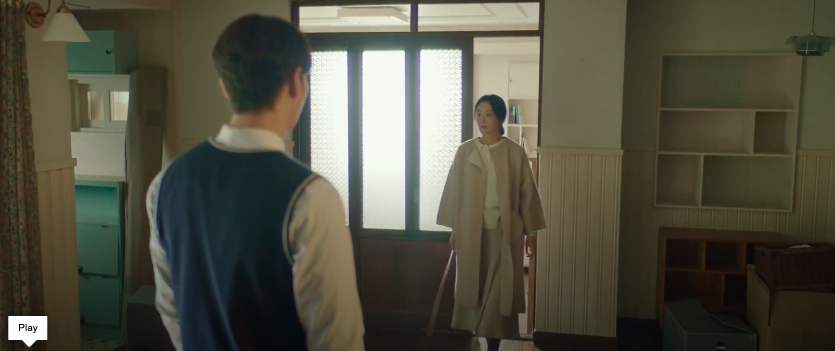
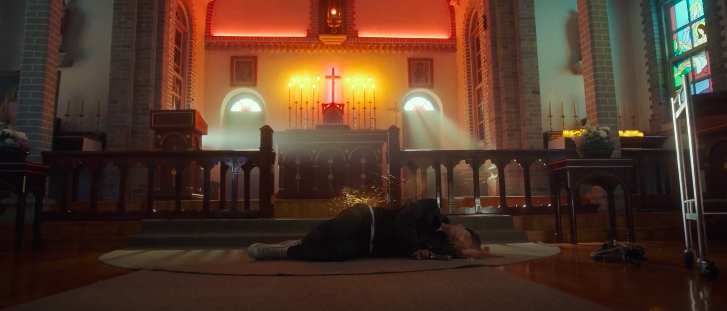
To some degree Sisyphus does that. Sisyphus succeeds in ways where Alice fails. There are hints of supernatural forces at work before the big reset at the end. The church is symbolic of that. Sigma himself clues us in that there is something special about the church. That's why he built the uploader close by. The church where everything always ends in the time loop is the one surviving structure when war comes to Korea. Sigma touts the word "miracle" when he refers to the church. The final confrontation has always been at the church (the memories, the photographs of the leads at the altar point to that) in which Tae-sul is offered the zero-sum choice of "the girl or the world". A sacrifice has to be made at the church and at the heart of Christianity is the sacrifice of the Son of God, Jesus Christ who gave himself for his Bride... his church.


Although I don't think Han Tae-sul is any kind of son of God, his choice to sacrifice himself on "sacred" ground sees him resurrected with his bride to be. He's back on the plane given a second chance to live as a reward for finally twigging and giving himself up to save the "world". The power behind the universe has looked upon his choice and approved by giving Tae-sul's heart's desire. To live and be with the woman he loves.


To understand this, I take my cue from the old time loop classic Groundhog Day. Phil relives the same day over and over again until he learns the lesson that he needs to. He has to learn that he cannot manipulate circumstances to go his way with prior knowledge but instead to use foreknowledge for good. He also has to learn that authenticity and self-sacrifice is the key to relationship success. Putting others ahead of self-interest... to love neighbour as much as self. It is never said who makes that decision to set Phil on his course but there's little doubt that there's a moral law or intelligence that exists teaching straying individuals that life doesn't revolve around them and their wants. As a result of coming to that realisation, Phil gets the girl. To find Ms Right, he had to be Mr Right first.

As for Sigma, he represents a kind of restless evil that good must constantly overcome. The roots of which run deep. It is true that time travel has been stopped so that instrument can't be used but evil will find new ways to steal, kill and destroy. It's the old Manichean dualism of good and evil in constant struggle over time.


Friday, April 2, 2021

Sisyphus: The Myth (2021) The end in sight

Somewhere in this hodge podge of romance, action adventure sci-fi and politics is a plot in search of a better script. Judging from all that I've seen in the past 7 episodes the potential for greatness was always there. The drama makes big claims, it wants to be weighty, it has tried to be mysterious keeping us all intrigued with a trail of breadcrumbs but there's little doubt that it is flawed project from the start. The stakes, we are constantly reminded, are high but the show using non-linear storytelling and an overabundance of flashbacks undermines its earth-shattering claims and diminishes any sense of urgency that the audience should be feeling. Instead the pacing is all over the place and the narration is weighed down by familiar tropes that often don't really enhance the way the package is delivered.

I don't think there's really anything that complex about the time travel side of things. From beginning to end it has been consistently about the problems associated with a temporal loop complicated by the possibility of temporal displacement if the past, present or future selves intersect. To my mind the confusion comes primarily because of the heavy-handed use of flashbacks. Flashbacks are used here for all kinds of reasons. Some provide glimpses of the leads' past while others give insight into the wartorn dystopian future. I'm not convinced that we needed that many scenes showing how Seo-hae and dad were living and surviving post-apocalyptic Korea. I don't see the point of us seeing her training regime after all this time. This is the sort of thing that would have been better shown at the start or not at all. But I suppose they needed some way of filling 16 episodes.

Certainly the show has to deal with some element of character. That's to be expected. But for one reason or another it feels clunky and not well integrated into the overall storyline. For me Tae-sul's character arc is better written and there's a sense of journey and growth. It's not that I think Park Shin-hye does badly as Seo-hae but her character isn't as well served here. It almost feels that her entire role in all of this is to be Tae-sul's bodyguard love interest. At least her training regime and skill set points to that. That said, I'm okay with the romance even if the leads don't have sizzling chemistry because it is quite an important feature of Tae-sul's evolution and it feeds his determination to do better than previous failed attempts at thwarting Sigma's foul plans.

Episode 14 offered some hope that Tae-sul is starting to think and act out of the box. It's obvious that some kind of sacrifice is expected especially when the story via Sigma has been sledgehammering us with a zero sum game all throughout. How many times has "is it the girl or the world" been thrown at our faces? Far too many I'd say. However, the question now is whether the show will be true to itself. I fear a cop out resolution. Of course that's just me bracing myself for the worst. Who knows the show might just surprise me a tad with some consistency.

Tuesday, January 5, 2021

Awaken (2020 - 21) Episodes 11 and 12

If you haven't watched the show or think that this is best thing since deep fried chicken... it might be best to give this post a miss.

Once in a while I ask myself why I'm still watching this show. But of course they're merely rhetorical questions. I know why I'm still faithfully... following it six weeks later despite the myriad of issues I'm having with it. It's in part for Namgoong Min, the laid back, somewhat reluctant superhero who has a penchant for lollipops (and now we know why as well) and spots a moustache. I am grateful for his newfound relationship with the moustache. It has come in handy during those moments when I want some kind of distraction from Seol Hyun's dazed, bewildered looks. It's obvious she does nothing for me performance wise and Gong Hye-won is, for the most part, a non-essential addition to the drama. I'm glad that the so-called love line between Hye-won and Jung-woo hasn't amounted to much. Plus it plays badly when the matter comes up.


Needless to say I am also persisting for the mad scientists plot. I'm fond of my sci-fi (the nuttier, the better) and it's a change from the time slip crime dramas that have graced our screens all year. They've established (and sledgehammered us over the head) with the fact that unconscionable men and women were doing highly immoral experiments on orphaned children 28 years ago on an island. And they still are in some secret location as the original White Night Village is now in ruins. 

Sometimes I wish this show was outright terrible so I can drop it like a hot potato with no compunction. But when there's progress in the plot, I cave immediately. And then there's Namgoong Min with his cynical smirk to contend with. When the show has these flashes of almost-brilliance, I feel like weeping because the feeling that it could be so much more never leaves me. The ideas are all there but the plotting needs a firmer hand.

In recent episodes the unhinged woman who called the shots in the old days has re-emerged, still calling the shots apparently. Choi Hyun-chee has evidently discovered the fountain of youth. She hasn't aged in the slightest so one can safely presume that she's injecting herself with something other botox to stave off the inevitable wrinkles. It seems to be the case too that the Chief Secretary of the Blue House, Oh Jung-hwan is popping pills to deal with his dermatological issues. Obviously the Foundation mob appropriated the anti-ageing formula  that Jung-woo's younger self worked out all those years ago except that he left out a few crucial details because he caught on that these were Really Bad People.

The third kid, Moon Jae-woong is apparently throwing an almighty tantrum against the world. Hence the serial murders by proxy. He is doing away with individuals who are/were connected with the White Night Foundation. It's old fashioned revenge. The tantrum also includes Jamie and Jung-woo. Apparently they cruelly left him behind except that they didn't really. He's either mis-remembered or has selectively remembered the events of the night they left the island. Or put a different spin on it. I still don't know if he has psionic powers but what's clear is that he is inducing lucid dreams using drugs and the watches are just a reminder or trigger for the victims to act according to his schedule.


Jamie has lately been relegated to being a recurring character or an extended cameo. Which is odd anyway you look at it. Considering that she is one of the the Three Survivors, her screen time seems absurdly paltry. Things are slightly better in Episode 12 for her. She's finally off to the island with the loud-mouth broadcaster to regain her memories and help us all the piece the puzzle together. I'm not sure why they bothered with the rain scenes in Episode 11. On hindsight it seems suspiciously like the show was trying to stall time so that all three of them could be on the island at the same time so that we could have the Big Confrontation. For Jung-woo to do his "hail Mary" also before the cliffhanger ending. 


The so-called Special Team or what's left of it is now demoted to the status of comic relief. I wonder why they bother. That said, they did make some small contribution in Episode 12 to saving a life and turning tables on Son Min-ho so that Jung-woo can be elsewhere. I'm also unsure as to why Hye-won happen to burst into the room at the right time to overhear a conversation when she's already resigned especially after her big speech about being disillusioned with the government. But I guess she just can't stay away and her timing is impeccable.

Sadly the women in this show are just not that well-written or well-utilized. We probably didn't need two female leads because it's increasingly obvious that they will remain largely underdeveloped. In the end, my feeling is that they are people in Jung-woo's life. Bystanders in his war against the evil Foundation.


Episode 12 was somewhat better. Things at least felt like they were chugging along, rather than the drama rehashing old ground. Yes, I get that the drama is attempting perspectival storytelling on some level but it doesn't do it nearly as well as many other dramas. In that regard I've been spoilt by better made dramas so I tend to find the pacing of this one rather slow. Frankly, the drama could have easily been achieved in 12 episodes. 

I wonder what Kim Min-jae (another survivor from the first cohort) will do now that he knows about the continuing experiments on kids. He seems to have a conscience and he's had his time as a lab rat. Of course not everyone is naturally inclined towards heroism even if they're having pangs of guilt. It is however, pretty appalling how the power that be think about the "test subjects" and dispose of them. 

Drugs seem to be a recurring motif in this drama. Whether they be experimental, prescribed or for recreational use... popped, sucked or force fed... it is a common thread. Whatever the show is trying to say, it's true to say that we are such a drug-dependant world. There's a ready-made panacea for everything including ageing it would seem. No wonder Big Pharma is raking in the big bucks. I can't help feeling though that often we'd rather take a pill than do the hard work of eating properly and exercising regularly (also thinking about Run On here with Mi-joo's supplements) or accept the limitations of being human. Science is a great tool but in the wrong hands, it is an unmitigated human disaster in the making.


Tuesday, December 29, 2020

Awaken (2020) and The Uncanny Counter (2020) Superhero Stories: A Study in Difference

 I've been on the verge of dropping Awaken at least once but because of the subject matter and the presence of Nam Goongmin in it, I've hung on by the slenderest of thread. He's always fun to watch (no matter the production's quality) and the character he plays here has consistently been the most fleshed out (thanks in large part to him I expect). I have no doubt he took on this role because Do Jung-woo is potentially a great character -- a Loganesque superhero of a type. NGM with his history playing antiheroes, is undoubtedly the right actor to slip into those shoes. 

While that's the case, the script thus far (we have reached the halfway mark at the time of writing) is to my mind, weak. Floating in the ether that is Awaken are some really good ideas. If you've read my previous post on this, you know that I've always maintained this. The origins of the White Night Foundation and the subject of experimentation on humans if handled well, makes for a great story. It won't be anything startling original but putting a Korean flavour to it would be something worth exploring. I wouldn't go so far as to say I have a love-hate relationship with but I am disappointed that most of the characters especially the ones supposedly on the side of "right" aren't very well written. There's been a bit of controversy about the women and how they feature as romantic interests or not. But to me that has always been more symptomatic of the wobbly script. I don't think the show knows what to focus on or to keep the main thing the main thing. To be frank, I don't know if Gong Hye-won is even a necessary character at this point except as a possible romantic interest or to create a conflict of interest for Jung-woo. All of that might make for compelling viewing if the writing could convince me that it's needed in this drama.

I'm unabashedly fond of crazy sci-fi. I've been watching crazy sci-fi long before I started watching Korean dramas. So it wasn't especially hard for me to see where the show was going with the White Night Village practically from Episode 1. I wasn't a hundred percent certain at the time but I felt that I was in the ballpark. True enough the parts of the show that I'm most attentive too concerns the ominous cabal known as The Foundation which was formed to finance experiments on children. To what end? Just to create a miracle drug? To find the key to longevity? Or something far more sinister... along the lines of Dark Angel or The Pretender perhaps. 

The Foundation appears to be mysterious assortment of the wealthy and powerful. All male... as far as we've seen. But the chief scientist from when Jung-woo was living in White Night was a woman. Her absence in the present is conspicuous. The present cohort that make up the Foundation seem to me (at least) to have their own individual agendas. I don't think that they're one united group. The chap who is the president's chief secretary... who has recently been in the spotlight lately... seems to have his own angle that probably involves a member of his family.

I suspect most of us are in general agreement with Jung-woo that the Foundation and what it represents is an abomination. The moral and ethical implications alone are just mind boggling. I think by now we have a decent grasp of who Jung-woo, Jamie and Jae-woong are. The 3 Js as it so happens. Things were done to them perhaps even while they were in test-tubes. They were unique in that they survived. Two of them even managed to get away. Our curiosity is piqued: why did the rest die and why did they not only survive but become Korean versions of the X-men? I am supposing (presumptuously perhaps) that this is the part of the show that we're all really responding to because it is the most consistently coherent part of the drama. 

In the morass of multiple moving parts including a serial killer case, politics and corruption, there is a superhero story that's gradually emerging. On the surface the show purports to be a police procedural although that doesn't fit comfortably. On some level that gives Jung-woo a context to do what he does and an excuse for some kind of romance between Jung-woo and Hye-won. Which I'm not a fan of mainly because the actors don't have that kind of chemistry for me. 

In comparison we have The Uncanny Counter. It's clear even with the most cursory analysis,  that the drama doesn't do anything startlingly original. To be fair, it doesn't pretend to. I can certainly see the comparisons with Mystic Pop-up Bar and perhaps even Missing: The Other Side. Two examples from this year's offerings. However, despite all of that, the show does what it does remarkably well. It is a reminder that though originality can be an asset, it is only an asset in the right hands. It's also a reminder that it's far more important to take care of the fundamentals... like storytelling, casting, character development and relationship building etc... and get them right before reaching for gimmickry and suspense for suspense sake.

Right off the bat we know exactly what the drama is. The intro says it all. It's unabashedly a superhero team-up story with fantasy elements. It starts off fairly predictable, formulaic even... following a superhero origins story almost to a T. Yet it is now breaking rating records for OCN. So predictability isn't necessarily a screen-writing sin. Neither does it represent a minus for engagement or widespread appeal.

What the show does well and often that's where others fall down is that it gets the balance right. It's the secret sauce. The show doesn't fall into the trap of meandering and giving more than it needs to because it knows exactly what it wants to be. The best part is that the show gives me exactly what I want even when I didn't know I needed it. It also strikes the right note with its comedic and emotional moments. 

First and foremost, the women are done right here. And I don't mean that they are trained in martial arts and can go toe-to-toe with the baddies and strut their stuff. While that's great and wonderful on some level, what's even better is that they are well-fleshed out, have strength of character and their nurturing instincts remain intact. Perhaps it's just me and the kind of shows I've been watching lately but I have less and less patience for wacky, over-the-top female leads who use disproportionate violence, as a way of playing one upmanship with the male leads. Some of that may be played for laughs... don't know... but I'm finding it tiresome. In contrast, I love how Ha-na is written and portrayed as an older sister figure. She's an angry girl but there are other dimensions to her. I also especially love what Yeom Hye-ran is doing with Mae-ok. She's a take-charge, motherly character who can bare her teeth when that's called for. They both feel real. Not like caricatures. I have similar sentiments about Detective Kim Jeong-yeong. She's weathered many storms in the police department and she hasn't backed down from her principles. These are strong, smart women because they've endured much and been true to themselves without trying to be like men. Or trying to prove something for that matter.

Next, the cast chemistry is super good when you consider how diverse they are and the age differences. They've got a great group of actors that interact so well together especially as each of them mentors So Mun in their own way. Jo Byung-gu is himself a rising star but he knows how to be part of an ensemble without the need for overacting on his part. Even though there's apparently supposed to be no romance between Mun and Ha-na, the chemistry between them is good enough if the showrunners are keen to take their relationship to a different level at a different time. The show itself knows romance isn't needed the usual jokes are made about it. But there's no denying the chemistry between the pair.

And of course Mun himself is a great character. As I've said before Mun was standing up to school bullies and baddies well-before he had superpowers or had two working legs. He already had a hero's heart like Steve Rogers aka Captain America. What he needs to learn is to control his emotions, become stronger and choose his battles carefully but he has always been a good-hearted, gutsy kid who accords respect to his elders. Everything that the show does with him contributes in some way to his development and the overall storyline. 

Finally the integration of all the moving parts appears seamless. Everything fits together really well. Sure, the gallery of rogues here aren't anything we haven't seen before, neither is the corruption angle ground-breaking stuff. There's even a serial murderer on the loose here. But it's so far well incorporated into the demon-hunting side of things and the characters' own individual trajectory. No one is wasted or is extraneous in the storytelling. 

This is not to denigrate the achievement of Uncanny Counter because it should be given credit for its disciplined, tight plotting while managing to connect the audience with the characters and key character moments. It does just about everything right with the material because it never tries to pretend it is anything more or less than what it is.

Personally I think Awaken could have taken a simpler approach. The mystery within a mystery technique used to indifferent effect was supposed to create suspense and signal a darker tone but all that ended up feeling fillery because it was never the actual goal. The whole thing about using children as experimental subjects is already a dark subject with its own story potential with all kinds of political reverberations. Maybe it should have been a 12-episode drama. But then a good drama about the Foundation and its shady dealings could easily provide material for a 16-episode drama.

Sunday, September 20, 2020

Alice (2020) Episodes 7-8: Teasing Tropes or Taboos?

To be honest I'm not entirely certain where the show is going with some of the character threads. Admittedly unpredictability is one of the attractions of this highly ambitious drama. One is never quite sure where the show is taking the audience on this rollercoaster ride. I must confess I'm not a fan of the show's flirtations with Oedipal taboos. I use the word "flirtation" because at this point at time that's all it seems to be. It's clear the show is playing monkey with audience expectations with regard to possible lovelines. ("Are they? Aren't they?" The manipulation of camera angles and the emotional OST plus some of Tae-yi's more pointed questions about Jin-gyeom's feelings for her lend weight to this perspective to some degree.

My own view on Jin-gyeom's dynamic with 2020 Tae-yi is due to her striking resemblance to his mother and the perpetual question that preoccupies him as to whether she is his mother. Based on what we've seen so far, I am also of the opinion that she is his mother's younger self because the mechanics of the temporal device here is not thoroughly explained... at least not to my satisfaction... because of the inconsistencies. But then the whole idea of time travel is problematic whichever way one looks at it. Who knows perhaps in some other parallel universes Jin-gyeom's relationship with Tae-yi is not familial. My problem with that proposition of course is that Jin-gyeom is Future Tae-yi's son with Min-hyuk. So if he's in a romantic relationship with some other Tae-yi somewhere out there, who's son is he? I don't know about anyone else but this throws up another layer of complexity that is begging for answers I'm not sure that the show will be offering. But none of us can be certain about much when there are still 8 episodes to go.


The other thing that troubles me is that Mother-Future Tae-yi and younger Tae-yi both co-existed in the same timeline so it seems that they're two separate selves. But then from time to time younger Tae-yi seems to have vestiges of Mother Tae-yi's memories. Are these sorts of inconsistencies going to be explained later on? 

Jin-gyeom... as far as one is able to read him... is largely fascinated with present Tae-yi because of the guilt that weighs on him for failing to protect his mother not once but twice. Whether or not he can ascertain her identity, many odd, inexplicable and even dangerous occurrences have brought them together  His seeming attachment to her, I believe is about that and a long-felt regret for not having been a more attentive son to his mother while she was around. The early sequences of Episode 8 point to that. Do-yeon's timely/untimely intrusion into the safe house suggests that the show teases out the time honored cohabitation trope and then pulls back. It established early on that Jin-gyeom doesn't have strong connections with many people. Mother Tae-yi was one, Do-yeon is another, Ahjussi and his wife make up the rest of this select group. It took years for them to build the bonds they now share. Even now he still has trouble identifying his emotions and yet there's no doubt he cares for these people more than others. So it's a stretch, to my way of thinking, that he would fall for in love with present day immature Tae-yi with all her unique quirks just because she looks like his mum. Even the ambiguity that surrounds his accommodation of her whims and demands seems to be associated with his memories of Mother Tae-yi.


It's not (just) about the ick factor that I object to a possible romance between Jin-gyeom and 2020 Tae-yi but the internal inconsistencies it creates within the storyline. Okay he hugged her and cried like a baby when he first saw present-day Tae-yi but only because she is a dead ringer for his mother -- the only person in his life he ever wept bitterly for.

Then of course there's the problem of Min-hyuk who's been conducting time travel tourism in Jin-gyeom's timeline. The same Jin-gyeom who is a progeny of his beloved Tae-yi. Jin-gyeom is their offspring and they're interacting. If indeed Min-hyuk is supposedly operating in a parallel universe why does the case file for Lee Se-hoon have his mug shot in it. Is this a fixed event that occurs in every universe? How does this work? Then there's Mother Tae-yi's time card which he took back and is now being looked over by the Alice crowd. 


If there's anyone I root for, it's Min-hyuk. He seems to be much better fleshed out character than first meets the eye and then there's Kwak Si-yang's thoughtful performance. For someone who is supposed to be in charge of such a groundbreaking enterprise, he knows so very little. Despite the bluster he still hasn't moved on and he doesn't even know that he's a dad. He cared much more for her than the early episodes indicated. But he soldiered on nonetheless. And really that's it... he is a soldier in a cause who paid the price for it because he believed that what he was doing was a good thing. He hasn't read the forbidden book so he doesn't know that the time travel project that he's a part of is a pandora's box. 

In Train (2020) at least it was clear to me that the universes were two distinct locations with very different outcomes for just about every single character. The point from which the differentiation occurred was at least defined. There was an event that caused the branching-off that leads to different consequences.

Here my problem with the multiverse theory is about returning to the point of origin. How is that achieved? If there are that many alternate/parallel universes out there that results from all the time travelling that goes on, how does anyone get back to the moment that started it all? It's one thing to create an alternate timeline (as posited by Seok O-won) but it's another thing to leave it and then return to it. If there are so many of them, how do the time travellers know which one to go back to? Does the wormhole principle here work like that of the Stargate franchise?

I need explanations!

As I said last week, I'm not seeing parallel universes here in the same ways as it occurred in Train but an accumulation of paradoxes in the form of causal loops. We have future selves meeting past selves; future selves going back to the past and then having progeny in the past.

My mind is undeniably boggled. I do wonder if the multiverse thesis is just a red-herring or a mistaken assumption on the part of some which is why time travel becomes a complete trainwreck and future Tae-yi  co-opts O-won to put a kibosh in the entire project.


Sunday, September 13, 2020

Alice (2020) Episodes 5 and 6 : Of Pandora's box and Paradoxes

The biggest surprise to me about this drama is that it really does want us to take the "science" in science fiction rather more seriously than one might expect it to. One some level the name dropping (eg. Schrodinger's Cat, Heisenberg's Uncertainty Principle etc) might just be window dressing... "Attention! Attention! You are watching a time travel-multiverse story" but the fact that the writer is making the effort, is almost commendable. There's almost enough gobbledegook to rival that of an episode of Star Trek: TNG. It's really rare in my experience to see a K drama go to go to all the trouble of analysing and discussing the moral intricacies of playing peek-o-boo with the past. 


By now we're meant to understand that the Alice project is not all that it's cracked up to be. Good intentions are not always matched by reality and outcomes. While Alice might not be an abject failure (yet), it can't entirely live up to its lofty aims of wanting to better the lives of people or alleviate suffering. It also appears, rather worryingly that the people behind the Alice project aren't entirely cognizant of all things time travel, much less about the competing interests within that space. There's talk about parallel universes and other selves in existence but there's no notion of paradoxes of future selves becoming part of the past and integrating their footprint in a single timeline. If there had been (at least) two separate timelines before, they seem to have now collapsed into one apparently because of Tae-yi's decision to remain in 1992. Seok O-won seems to have some awareness of this having the benefit of hindsight taken from the so-called Book of Prophecy. 

Prophetic utterances and oracles within this universe seem to the ramblings and chronicles of time travellers who have witnessed the future firsthand, recorded key events and left them behind for posterity. How the book found its way into Dr Jang Do-shik originally and Seok O-won's hands eventually at various times are still mysteries that need to be revealed in due time. Playing pass the parcel with the book itself seems to imply that there is one timeline at play rather than multiple ones. Unless of course there are multiple ones circulating in parallel worlds.

The contestability of time travel may prove to be the most fascinating aspect of the drama. It's also a new twist to Kdramaland's increasing macabre fixation with serial murders. A good excuse to raise the body count. It isn't just the tourism murders that call into the question the entire enterprise but there are other murders involving rough looking men with long hair and leather jackets who have a thing about dead cats. Who are they taking their orders from? It seemed initially that Seok O-won might be behind this and yet it is possible that there's a third party calling the shots. The contestability of time travel will undoubtedly turn it into the pandora's box that Seok O-won hints darkly at. It's a double-edged sword depending on who's wielding it.

The time card brings Min-hyuk face to face with the woman he loves and is stopped in his tracks. Is she his Tae-yi? According to Schrodinger's thought experiment... the answer is no... and yes. He knows her but not her as she is now but as she will be. But to add insult to injury he thinks she's another Tae-yi from a parallel universe, out of his reach. Are we all sufficiently discombobulated yet?


Min-hyuk is wrestling with the same issues Jin-gyeom does. Who is this woman? Should he care? As long as she doesn't have memories of him, she can't be his Tae-yi. Just as Jin-gyeom has concluded that the professor can't be his mother. Appearances, habits and personality aren't everything if they have no shared memories. According to the premise laid down here, her identity is not necessarily determined by who she thinks she is or what she does alone BUT by how she is perceived by the people who know her best. Tae-yi from 2050 apart from being a scientist was also someone's lover and then someone's mother.

The time card is the key... not just for accessing the temporal mechanism but the key to all those involved in this relationship web to find out the truth about the past. 1992 and 2010.  Min-hyuk's entry at this point in 2020 Tae-yi's existence suggests that the show might be avoiding an icky Oedipal scenario. Although the constant sparring between father and son might indicate otherwise. Certainly on Jin-gyeom's side, his interest in present-day Tae-yi is purely for the fact she resembles his mother in striking ways. He must also feel some responsibility for drawing her into this dragnet of inexplicable danger that grows even more inexplicable as the web of intrigue expands to include a whole assortment of unsavoury characters that have come from nowhere.

Oh Shi-young is a curious and suspicious figure. One wonders about her role and possible presence on the night of Tae-yi's death in 2010... as signalled by the drone. But the really curious thing is why she's been feeding Min-hyuk porkies about Tae-yi moving on and living the good life and the death of their baby. To help him forget and move on so that he would turn his attention to her? That's a likely explanation. And he is undoubtedly walking eye-candy in a suit.

More than that, she must know that Tae-yi left behind a son. His and her son. Whatever she might be trying to convince herself of regarding parallel universes it doesn't change the fact that Park Jin-gyeom is Min-hyuk's son from that particular timeline.


The reality is that Min-hyuk hasn't moved on despite running around busily with a stoic resolve. Neither has Jin-gyeom despite his innate expression of stoicism. The passage of time apparently doesn't heal all wounds. Perhaps this explains Min-hyuk's quiet sympathy for his murderous clients. He himself is only too aware of his own grief that he keeps well-hidden from public gaze. 

However, the use of the past as a psychotherapeutic playground continues to throw up all kinds of troubling ethical questions. For an oligarchy with all their emotional baggage, not matter how well-intentioned, to adjudicate this life and death process, continues to be disturbing.

There's no denying the well-used tropes making their appearances here. It is still a recognizably K drama after all. However, credit should be given to the showrunners for using them in playful, innovative ways as it pertains to the time travel multiverse madness. It may be true that underneath all the other worldly elements beats the heart of a good old fashion K melodrama.


Sunday, September 6, 2020

Alice (2020) Episode 4 -- A Cursory Analysis of the Big Ideas *Spoilers*

I was amused and somewhat gratified to read Choi Won-young's latest character mouth the very same lines that I had written in my previous post. All the predictably good stuff about "just because you can doesn't mean you should", "this is an intrusion into the realm of the gods" etc etc. It's clear that the show is presenting him as an antagonist to the prevailing Alice narrative although it's unclear how much of that hostility plays out in actual violence. Seok O-won, the head of the Kuiper Institute of Advanced Sciences, believes that time travel is possible. A charismatic man of science to boot. He is the first one from 2020 to state that unequivocally but he also styles himself as a critic of it. It's a dangerous proposition and it's not hard to see from recent events that he has a point or two. Science is a tool, neither good or evil in and of itself but in the wrong hands, it can go very very badly not just for the person who uses it but for others around them. 


My fascination with Alice lies mainly with its philosophical underpinnings and explorations. The big ideas of life, that sort of thing. I don't think it does anything spectacularly different from a lot of sci-fi and perhaps visually some aspects of it might seem a bit cheesy. But the storytelling is very good and what it tries to do, it does well. Besides I'm always a sucker for a decent police procedural even if it takes a back seat to mind-bending sci-fi.

People are getting murdered and not all of them are mysteries.  The audience is privy to the ins and outs behind the bloodlust. The ones that remain unsolved up to this point and the ones whose motives are known. Both feed into the overarching moral dilemmas related to using time travel supposedly in the betterment of humanity's lot. The debate is this: Just because we can use time travel to do good (in varying degrees) there are costs... and trade-offs. Do the gains outweigh the losses? Are the gains offset by the losses? It's a crucial principle that should inform all manner of public policy on all levels. This is a point well-made during this season of Covid-19. To put it in medical terms, "Is the cure worse than the disease?"

When the head honcho of Alice, Ki Cheol-an says to a defensive Eun-soo's mother that by killing her 2020 self, she has now left her beloved Eun-soo without a mother. The show allows the full weight of that statement to land on the grieving mother. A gentle rebuke of her blind selfishness. Not too many will quibble with the fact that she loved her daughter and she was still grieving in 2050 that her daughter had died at 17 because of a single event. She blames her past self for being lax and complacent and thinks she would do a better job equipped with foreknowledge. But as the scenario plays out, the murder is inevitably discovered because let's face it the lady is hardly a criminal genius. 2050 mother is now on the run from 2020 law enforcement and needs rescuing. On top of that 2020 Eun-soo is now motherless and Dad is wifeles and grief-stricken. The future for them might arguably be bleaker than before. In a fit of emotional rage with no one to hold her back, Eun-soo's mother commits an irreversible crime. 

The incident also highlights the difficulty of prediction. It's almost impossible for us mere mortals to know what will happen. It is possible to look at history and make a few good, educated guesses about the big picture of where the world is headed. That's certainly not beyond the pale. But on an individual level, it's much harder. How many times have we said... or heard people say, "Never in my dreams did I imagine I would be doing XYZ" or "If you had told me when I was 20 that I would be in this position now blah blah blah"? If only I had $10 for every time I've heard it. Whether the outcomes are net positive or negative one can't be sure that while one is in a middle of living life if one's life is a tragedy.

With regards to Eun-soo's mother she was so fixated with the one event... the death of her daughter... that she forgot about the good times that they shared. In 2050 she was trapped in the past that was 2030. Revisiting the past could have been helpful in the grieving process but it was more about course correction which led to the overreach and then murder. In the end she swapped one form of grief for another.

The other so-called related moral lesson for all concerned is about how humans deal with suffering and grief. Again, universally and perennially topical. Again, this has long been the subject of science fiction. The film Equilibrium, a favourite after the manner of Fahrenheit 451 springs to mind. A stoic utopia "no place"... or more appropriately dystopia created with the underlying assumption that eliminating emotions is the only way to control human beings and gain a peaceful society. In Serenity, a similar project was also undertaken by the government to turn everyone docile except for the fact that it led to serious, deadly side effects to creating that brave new world.

To me history proves that our world is a fallen one filled with flawed, broken human beings. Death is a reality. History is replete with examples of how human beings make the same mistakes over and over again. Much suffering is tied to that. In some ways progress has been made over time but it doesn't take much for regression to barbarism to emerge. Lord of the Flies is a sober reminder that without constraints... legal, social and personal... things fall apart fast. Good intentions can end horribly badly.  Once again, I refer to Eun-soo's mother. She's the anthropomorphic metaphor here of those who grieve and can't move on. Perhaps there is even a certain perceived nobility in that... remembering, never forgetting. Like what Jin-gyeom says to his adoptive father and mentor, Go Hyeon-seok. You don't forget family. I doubt it's a statement that anyone who has lost family would ever disagree. But there comes a time of moving on which is not the same as forgetting. It means concentrating on living out the rest of one's life without the one that is lost. Overcoming it is a part of life. We all do it in different ways. At my mother's funeral we talked about her, we cried, we laughed and we hugged each other. It was very hard the first year but I credit my children for "compelling" me to focus on the moment, focus on what I had  rather than what I didn't. The belief in the afterlife, the hope that she was no longer suffering and that we'll meet again one day... all of that helped me to "move on" as well.

It's crucial to learn the right lessons from grief and loss. That was also the message of It's Okay Not to be Okay. Suffering can make or break a person. When someone grows stronger from it, resilience is the fruit.

Time travel seems especially important for people who have no hope of an afterlife reunion. I think the talk of church, religion and gods in this episode is suggestive. Those who pin all their hopes on science might believe that science has the potential to address all of humanity's problems. No one denies that the application of science across the board has brought a myriad of benefits.  But humans are more than bodies and science is limited in what it can do for the longings of the heart.

It's certainly not a new idea of science alleviating suffering or removing it altogether. I imagine that's why the pharmaceutical industry does as well as it does despite all the cynicism concerning its activities and the power that it wields. But what is the trade off of that? An unhealthy, hubristic vision of our ability to deal with things that are beyond our control? Pinning our hopes on something that can never satisfy? Or a risk averse culture that coddles the young?


Seok O-won's view of time travel is worth chewing over. From what I understand he doesn't believe that changing the past can change the present/future. What it does is create an alternate one. Essentially the past cannot be changed, only the future. So he seems to subscribe to not just the multiverse theory but also alternate timelines. The original timeline that the traveller comes from remains largely unchanged but at a certain point it branches off in a different direction due to the (inter)actions of the traveller. Like Star Trek 2009. So it seems there are no father paradoxes in the Terminator sense, just alternate selves living and making different choices due to different levels of knowledge. This could well be the underlying principle of Alice. 

That of course opens up other serious moral and ethical issues. It isn't just a case of going back and committing murder to change things. There is the issue of "rights" and authority. What are the implications for others when we do this? Who arbitrates this universe hopping? This is my problem with the Alice management. They've made themselves the Lords of the universe when they have no omniscience. This is exactly Seok O-won's point. It's a power that human beings can't handle. This is more dangerous than a ghost story where people complete unfinished business before going to the afterlife like in Mystic Pop-up Bar. 


All good stories are ultimately about family in some form. Families are essential, a headache and often a lifelong grief. Interpret that how you may. But they're a human impulse because it's a place of belonging. No one should be alone. Both Tae-yi and Jin-gyeom end up being orphaned at some point and are adopted by kindly souls along the way. Go Hyeon-seok and his wife lost their own son and they did what they could to make sure that he had a home after his mother death. Eun-soo will now be motherless. Min-hyuk who is picture of stoicism to his colleagues is adamant that despite being the poster boy of professionalism he is capable of grief. He grieved and is probably still grieving for the family he lost. Or more accurately, the family he doesn't know he has. Jin-gyeom was fatherless... and then he was fatherless and motherless before moving in with the Gos. The little girl at the beginning of the show Dr Jang's daughter was motherless apparently and then she was fatherless. She may or may not be the little girl who becomes the Tae-yi who grew up in the orphanage.


Min-hyuk finding out Jin-gyeom is his son is high on my list of things I anticipate. Especially when all they've been doing is facing off each other. Will it be anything like Tunnel? It's not clear at this stage why he believes that their baby died and who has been feeding him porkies in that regard but I wonder about Ms Controller in the operations room who is watching him with her big colour tv.

Friday, September 4, 2020

Alice (2020) Episode 3 *Spoilers*

This is my favourite thing on K telly right now. It has the potential to be a great show, one of the year's best. Will it be another Life on Mars? It's too early to say. I certainly hope so because good sci-fi is always hard to do but this one seems to have a better decent script guiding it. Let's hope and pray that it can be sustained right to the end. 

My favourite sci-fi... the best ones are thoughtful and inevitably philosophical. Whatever the tech and the context, preoccupations with the human condition are front and centre.


It's clear that Yoon Tae-yi's re-appearance in his life knocks Jin-gyeom off his general equanimity. As he wrestles with not just with her uncanny resemblance to his long deceased mother, spars with his birth father and grapples with the unfathomable possibility of time travel, his confusion about this new reality is exacerbated by inexplicable murders. Last week we had a future self travelling back to the past to kill someone who had wronged and embittered them. This week a mother kills her past self for not doing enough to protect her daughter and makes a failed bid to be a substitute. It goes beyond irony and paradoxes. She punishes and kills her past self for being inadequate as a mother in the belief that she, the future self, can do better because of hindsight and foreknowledge. Seems extreme. However, future Mum has brought something potentially life-threatening with her to the past. It does beg the question as to whether it is a result of the time travel or the collision of past and present or some new pestilence hitch-hiked from the past.

Of course there are consequences and the lesson seems to be... "just because you can doesn't mean you should." It's one of those things one learns as a child from the adults around us as a caution about leaping into places where even angels fear to tread. A cautionary advice against hubris and the breaking of fundamental moral principles. It's often been used against genetic modification of foods. It's a warning against playing God. It's the age old question of whether humans can really control nature without it coming back to bite them.

I don't want to be a wet blanket. Time travel sounds like fun. As someone who enjoys learning history, I've fantasized about going back to certain key moments in the past like in the drama to witness of events unfolding. But I've watched my Doctor Who and my Star Trek so I know that it is a bad thing to change the past no matter how well-intentioned. One doesn't know what happens to the thing called the space-time continuum.

I gather from the first episode that people have been time travelling for a bit with relative success. So why the anomalies of the last few episodes? I imagine that the show will provide the answers to that. Hot Dad aka Min-hyuk attributes it to a particular psychological profile. It may well be that. Or there could be much more to it.

For a project/ endeavour the Alice crew are a noisy lot bringing a lot of attention to themselves. Take the big gunfight in the library for instance. Some of it was having to clean up after somebody else's mess but maybe they're counting on the fact that no one finds the entire idea of time travel possible in 2020. I suppose they're setting up these confrontations between father and son in anticipation of some kind of reunion. Since this is still a K drama, I'm not expecting an Oedipus Rex scenario. 

With the time card now in Tae-yi's hands, I wonder if Jin-gyeom has created a time loop in the manner of the "hasta la vista baby" Terminator franchise. The quote at the start of the episode, "There is no coincidence in fate. A man makes fate itself before he meets it" sounds similar to Kyle Reese's "The future is not set. There is no fate but what we make for ourselves."


Monday, August 31, 2020

Train (2020) The Joy of Parallel Universes *Spoilers*

During my BC (before children) days, in the late 1990s when we would regularly make our way to the movies, there was one we got to that has stayed with me. It's was a Gwyneth Paltrow flick about a woman living parallel lives contingent on her barely getting on a train or missing it. According to the film, Sliding Doors, this is the pivotal moment that determines the course her life from here on. I remember mentioning later to a colleague that this show was surprisingly fatalistic considering that it was presumably made for a largely secular western audience. Of course on hindsight, over 20 years later and after much consumption of screen sci-fi over the years, it's clearer that embedded in alternate/parallel universe stories are time immemorial preoccupations with the metaphysics of predestination, character and social determinism.

While I was binge-watching Train over the weekend, my mind would occasionally wander to Sliding Doors for their similarities but also for their differences. The former is clearly much more firmly fixed within science fiction multiverse theories while the latter is locates itself more simply as a "what if" kind of story. Parallel universe stories in my experience are as much about what's similar as it is about what's different.  In every instance, it seems to me that there has to be a key, defining moment that causes that differentiation between worlds... or to put it in scifi jargon... a split or disruption in the space-time continuum. To understand how this particular multiverse works, I invoke a tree as the analogy to illustrate this. The trunk of the tree denotes the start of the key defining moment from where all the multi-universes branch off  and at some point certain events branch off into their own separate trajectories. To my mind, it works roughly in the same way as alternate timelines. Star Trek 2009 is a clear example of how this works. The storytelling involves same people but their individual trajectory in the alternate universe/timeline is created when an anomalous event disrupts the original/prime timeline.


As much as the parallel universe side of things dominate much of the drama, this is still very much an OCN style crime show. There is injustice to be righted. There is a serial killer to be caught. There are morals to be pontificated. There are twists and turns to navigate all throughout even if the identity of the culprit comes as no real surprise.


The lead character Seo Do-won is a detective with a past. (Don't they all!) Do-won has a reckless streak and will do whatever it takes to nab the bad guys. He also carries a large chip on his shoulders. 12 years earlier, he stumbles upon evidence fingering his alcohol-dependant father for the murder of another man -- the father of the woman he grew up with and has more than brotherly feelings for. She, Han Seo-kyung, has also become a crime fighter in her own right, a compassionate prosecutor who wants more from their push-pull relationship. His branch station chief, Oh Mi-sook, who ends up raising both of them was the lead detective for that case. To protect the young people in this seemingly ill-fated connection, she convinced him then not to turn in the incriminating evidence. Fortunately but still tragic for all concerned, Do-won's dad was fatally wounded in a hit-and-run during that same night and so the murderer from 12 years ago was never officially caught and identified. As a result of the spectre of this family melodrama hanging over his head, Do-won's feelings for Seo-kyung are complicated by obligation, guilt and genuine affection. 

One night when Do-won's dogged pursuit of a suspect ends up in a disused section of a railway line, he stumbles onto a poorly concealed serial killer's grave. This find initially turns up the skeletal remains of four unknown women and some familiar-looking jewellery. As the investigation into these serial murders deepens, Seo-kyung gradually comes to the conclusion that Do-won's dad might not have been her own father's killer after all. The answer, it would appear lies with the now abandoned Mukyeong Station and as she gets too close to the truth for comfort, Seo-kyung is permanently silenced by someone who appears to be the perpetrator.

As the distraught Do-won begins to put the pieces of the puzzle together, he is led to a mysterious train that takes him to a parallel but somewhat antithetical Mukyeong where his other self, also a detective, is a fugitive on the run for allegedly gunning down a known drug-dealer. It is at this juncture that the two selves while in pursuit of the serial killer cross over into the one another's universe. Do-won B is quite a different beast altogether supposedly because 12 years earlier, he arrived in time to save his father from the hit-and-run accident. Unlike Do-won A, Do-won B did not meet Seo-kyung and save her from her abusive step family. In the B universe both grew up separately and differently. As far as Seo-kyung B is concerned, Do-won is the son of the murderer of her father.


Complications ensue but Do-won A is consoled to see his beloved Seo-kyung alive in another iteration in this parallel world where his other self is a bitter, resentful junkie. This Seo-kyung only know Do-won as the son of her father's killer. She is immediately hostile and rejects his overtures of goodwill. Wisely he assumes the identity of the other Do-won to investigate the case. The people around him while they notice personality differences, are too busy and too blase to ponder the reasons. Or so we're told. Seo Do-won in universe B is not well-liked and so no one cares enough to probe. Besides, his colleague seem to prefer the change. Other mysterious occurrences emerge while Do-won A navigates the differences in the parallel world which inevitably lead back to the identity of the serial killer.

The show does a reasonable job differentiating the parallel Mukyeongs through Fringe-inspired use of special effects and subtle costume changes. I am surprised that there's a general lack of curiosity on the part of the other characters about the different Do-wons especially when the two selves find themselves in the same place at last. Perhaps we are meant to take it as a statement about how unobservant people generally are. ;)

Comparisons with The King: Eternal Monarch are inevitable considering the subject matter. Happily, this drama has the better script and deals with the parallel universe trope in a much more cogents and consistent fashion. Overall, it is better conceived, better thought through and better executed. It doesn't have the flash of The King to be sure but the storytelling is far superior. The 12 episode format undoubtedly helps. Not a lot about The King makes sense to me (big on ambition but little on plotting) but the character of Lee Geon is the most problematic of all. He comes across more a mannequin dancing to the requirements of the script than a relatable character.

A major part of why this show works has to do with Yoon Shi-yoon's wonderfully nuanced performance. Watching him in this is a joy. While the acting across the board is a mixed bag, Yoon Shi-yoon is in a class all by himself bringing both Do-wons with their subtle differences to life. Do-won A is the less embittered of the two and so the impact he has in his world differs accordingly. What both Do-wons have in common is an inhuman drive to get to the bottom of things. This will to persevere in the face of obstacles and survive incredible odds is what it seems makes the parallel 'verse hopping possible. 

Do-won's A appearance in Universe B reminded me of Frank Capra's It's a Wonderful Life. As he interacts with different iterations of people he knows in a different world, it is clear that his original trajectory had an enormous difference not just for him but to the people he rubs shoulders with from that time onwards. In the case of Jin-woo, Do-won's distinct presence in both worlds had huge ramifications for what happens to Jin-woo. What of course he didn't know at the time was how decisions made by persons in the different universes led to different outcomes which also had their own ripple effect on his life and the subsequent choices that he made. Do-won is not the first parallel universe traveller and each leaves their mark. It isn't a completely clear cut case of destiny at work or some kind of cosmic predestination because the show seems to point to human agency being a primary factor causing ripple effects. Undoubtedly there are fixed points -- from the basic fact that the same people exist in both worlds and often involved in similar activities. However it is clear that neither universes are immutable or static.

The most unexpected feature of  the show is that it attempts to offer some explanation of how the world hopping works. I don't normally expect that sort of thing for a K drama. Although the magic train works during the magic rain, there's apparently more than one magic train.  The show also speaks to the importance of individual autonomy. It makes a clear case for the notion that the presence or absence of a person can make a whole world of difference.